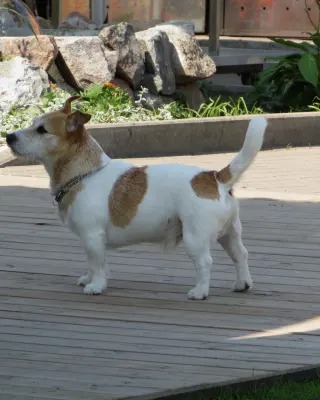
Plate 116 · British Isles
Border Terrier
边境㹴
“A border-country fox terrier with an otter-like head.”
- Origin
- United Kingdom
- Anglo-Scottish border (Northumberland)
- Region of origin
- From the hill country of the Anglo-Scottish border and long linked with the Border Hunt in Northumberland; the marker is Northumberland's reference point.
- The point marks the region the breed comes from, not an exact birthplace.
- Era
- 18th–19th century; recognized in the UK in 1920
- Today
- Companion · Earthdog
Under editorial review — sources listed below.
History
01 · Origin
Anglo-Scottish border (Northumberland)
A small, rough-coated working terrier with legs long enough to keep up with hounds and horses.
02 · Historical role
What it was bred for
Bolting foxes from their earths for the hunts of the border hills, and killing vermin.
03 · Breed development
How it changed
Called the Coquetdale or Redesdale Terrier after the area where it evolved, it was known as the Border Terrier by the late 1800s, probably from its work with the Border Hunt. It shares ancestry with the Bedlington and Dandie Dinmont. The Kennel Club recognized it in 1920.
04 · Today
Companion · Earthdog
A popular family dog, still a capable worker.
Personality
- Affectionate
- Happy
- Plucky
- Even-tempered
General breed tendencies, not guarantees — individual dogs vary with genetics, training and environment. Ratings: the AKC’s trait scores as its breed page gives them (the AKC’s 1–5 guidance for owners, not a measurement). Other profiles here use editorial ratings, a different source, so compare across them with care.
- Exercise
- A brisk half-hour walk or play a day; always on lead or behind a fence, since it chases small animals.
- Grooming
- Brush every week or two; strip out dead hair while it sheds.
- Training
- Good-tempered and trainable, but bred to think for itself.
Living with one
- Size
- Small
- Lifespan
- 12–15 years
- Coat
- Wiry, weather-resistant outer coat over a soft undercoat; red, wheaten, grizzle and tan, or blue and tan
Field note
In 2008 it was reported as the eighth most registered breed with the UK Kennel Club.
Recognition & today
- AKC
- Terrier Group
- Also recognized by
- FCI (Group 3, standard 10), The Kennel Club (UK)
- Popular in
- No reliable data
AKC: Terrier Group, recognized 1930.
Still a popular companion in the United Kingdom. AKC registrations: ranked 91 among breeds in 2025.
Sources3 references
- Border Terrier — breed information — American Kennel Club
https://www.akc.org/dog-breeds/border-terrier/
Registry · accessed 2026-10-14 · Registry status, group, size, life expectancy and registration rank; history as the AKC tells it. Ratings: the AKC's own 1–5 owner-guidance trait scores as the page gives them (energy level, trainability, barking level, openness to strangers, good with other dogs), not measurements.
- Border Terrier — Wikipedia
https://en.wikipedia.org/wiki/Border_Terrier
Encyclopedia · accessed 2026-10-14 · Coquetdale and Redesdale names, the Border Hunt, shared ancestry, Kennel Club recognition (1920), UK registration ranks.
- Border Terrier — FCI breed nomenclature — Fédération Cynologique Internationale
https://www.fci.be/en/nomenclature/BORDER-TERRIER-10.html
Kennel club · accessed 2026-10-14 · Country of origin Great Britain; Group 3, section "Large and medium sized Terriers"; accepted 1963.
Text is written by World Breeds from the references above; it does not reproduce registry descriptions. Location note: From the hill country of the Anglo-Scottish border and long linked with the Border Hunt in Northumberland; the marker is Northumberland's reference point.