Plate 122 · Continental Europe
Brussels Griffon
布鲁塞尔格里芬犬
“A Brussels cab-stable ratter turned royal favourite.”
- Origin
- Belgium
- Brussels
- Region of origin
- Named after Brussels; the marker is the Brussels-Capital Region's reference point. The FCI treats the Griffon Bruxellois, Griffon Belge and Petit Brabançon as three breeds; the AKC keeps them as one breed with rough and smooth coats.
- The point marks the region the breed comes from, not an exact birthplace.
- Era
- 19th century; first registered 1883
- Today
- Companion · Dog sports
Under editorial review — sources listed below.
History
01 · Origin
Brussels
A tiny, bearded Belgian toy dog with an almost human expression, descended from coachmen's stable ratters.
02 · Historical role
What it was bred for
Keeping rats down in the stables of Brussels cab drivers.
03 · Breed development
How it changed
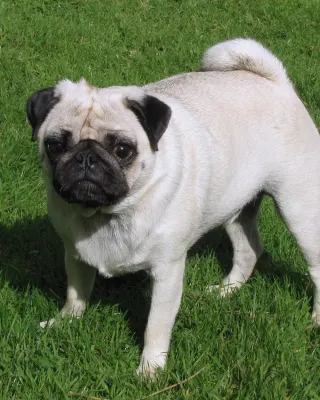
Coachmen's rough-coated stable dogs were crossed with imported toy breeds, including the Pug and King Charles Spaniel. The first was registered in Belgium's stud book in 1883, and Queen Marie Henriette's patronage made it fashionable.
04 · Today
Companion · Dog sports
A companion dog that also does well in obedience, agility and tracking.
Personality
- Alert
- Loyal
- Curious
- Sensitive
General breed tendencies, not guarantees — individual dogs vary with genetics, training and environment. Ratings: the AKC’s trait scores as its breed page gives them (the AKC’s 1–5 guidance for owners, not a measurement). Other profiles here use editorial ratings, a different source, so compare across them with care.
- Exercise
- At least half an hour of moderate exercise and play a day.
- Grooming
- Smooth coats need a weekly brush; rough coats do not shed and are often clipped short, except for the beard.
- Training
- Intelligent and closely bonded to its owner; easy to train with patience over house-training.
Living with one
- Size
- Toy
- Lifespan
- 12–15 years
- Coat
- Rough and wiry, or smooth and short; red, belge, black and tan, or black
Field note
A small rough-coated dog in Van Eyck's 1434 'Arnolfini Portrait' is often seen as an early relative.
Recognition & today
- AKC
- Toy Group
- Also recognized by
- FCI (Group 9, standard 80)
- Popular in
- No reliable data
AKC: Toy Group, recognized 1910.
AKC registrations: ranked 82 among breeds in 2025.
Sources3 references
- Brussels Griffon — breed information — American Kennel Club
https://www.akc.org/dog-breeds/brussels-griffon/
Registry · accessed 2026-10-14 · Registry status, group, size, life expectancy and registration rank; history as the AKC tells it. Ratings: the AKC's own 1–5 owner-guidance trait scores as the page gives them (energy level, trainability, barking level, openness to strangers, good with other dogs), not measurements.
- Griffon Bruxellois — Wikipedia
https://en.wikipedia.org/wiki/Griffon_Bruxellois
Encyclopedia · accessed 2026-10-14 · The three varieties, stable-dog ancestry, crosses with Pug and King Charles Spaniel, first registration 1883, Queen Marie Henriette, the Arnolfini painting.
- Griffon Bruxellois — FCI breed nomenclature — Fédération Cynologique Internationale
https://www.fci.be/en/nomenclature/GRIFFON-BRUXELLOIS-80.html
Kennel club · accessed 2026-10-14 · Country of origin Belgium; Group 9, section "Small Belgian Dogs"; accepted 1954.
Text is written by World Breeds from the references above; it does not reproduce registry descriptions. Location note: Named after Brussels; the marker is the Brussels-Capital Region's reference point. The FCI treats the Griffon Bruxellois, Griffon Belge and Petit Brabançon as three breeds; the AKC keeps them as one breed with rough and smooth coats.