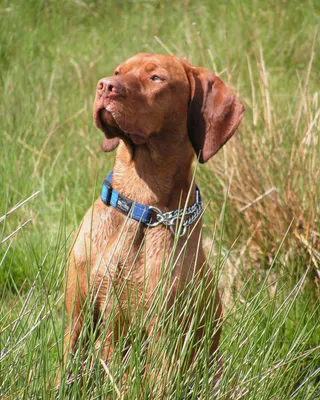
Plate 176 · British Isles
Pointer
英国指示犬
“The dog whose name is its job.”
- Origin
- United Kingdom
- England
- Country of origin
- An English breed; the sources name no single place, so the marker is the United Kingdom's reference point.
- The point is a reference position in the country of origin.
- Era
- 17th–18th century
- Today
- Gun dog · Companion
Under editorial review — sources listed below.
History
01 · Origin
England
An elegant, short-coated English bird dog that freezes to 'point' at hidden game.
02 · Historical role
What it was bred for
First finding hares for coursing greyhounds; from the 1700s pointing game birds for guns.
03 · Breed development
How it changed
Its ancestry is debated; the most common view is that Spanish pointers came to England in the early 18th century and were crossed with local dogs. William Arkwright's 1902 history found no truly convincing evidence for the Spanish origin but judged it the most likely.
04 · Today
Gun dog · Companion
A field-trial and hunting dog and an athletic companion.
Personality
- Loyal
- Hardworking
- Even-tempered
- Athletic
General breed tendencies, not guarantees — individual dogs vary with genetics, training and environment. Ratings: the AKC’s trait scores as its breed page gives them (the AKC’s 1–5 guidance for owners, not a measurement). Other profiles here use editorial ratings, a different source, so compare across them with care.
- Exercise
- Very active: long walks, vigorous play and a fenced area to run in.
- Grooming
- Minimal: a weekly brush.
- Training
- Amiable and trainable; many earn titles in several sports.
Living with one
- Size
- Large
- Lifespan
- 12–15 years
- Coat
- Short, dense, glossy coat; liver, lemon, black or orange, with or without white
Field note
Pointers seem to show the hunting instinct at around two months old.
Recognition & today
- AKC
- Sporting Group
- Also recognized by
- FCI (as English Pointer, Group 7, standard 1), The Kennel Club (UK)
- Popular in
- No reliable data
AKC: Sporting Group; registered in America from 1878 and recognized by the AKC at its founding in 1884.
Valued as a field dog; in the American South 'bird dog' often means the Pointer. AKC registrations: ranked 111 among breeds in 2025.
Sources3 references
- Pointer — breed information — American Kennel Club
https://www.akc.org/dog-breeds/pointer/
Registry · accessed 2026-10-14 · Registry status, group, size, life expectancy and registration rank; history as the AKC tells it. Ratings: the AKC's own 1–5 owner-guidance trait scores as the page gives them (energy level, trainability, barking level, openness to strangers, good with other dogs), not measurements.
- Pointer (dog breed) — Wikipedia
https://en.wikipedia.org/wiki/Pointer_(dog_breed)
Encyclopedia · accessed 2026-10-14 · The Spanish-pointer theory and other proposed ancestors, Arkwright (1902), the pointing stance.
- English Pointer — FCI breed nomenclature — Fédération Cynologique Internationale
https://www.fci.be/en/nomenclature/ENGLISH-POINTER-1.html
Kennel club · accessed 2026-10-14 · Country of origin Great Britain; Group 7, section "British and Irish Pointers and Setters"; accepted 1963.
Text is written by World Breeds from the references above; it does not reproduce registry descriptions. Location note: An English breed; the sources name no single place, so the marker is the United Kingdom's reference point.