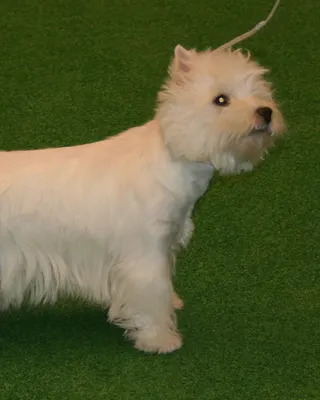
Plate 188 · British Isles
Sealyham Terrier
西里汉㹴
“A Welsh captain's otter terrier.”
- Origin
- United Kingdom
- Sealyham House, Pembrokeshire, Wales
- Region of origin
- Bred at Sealyham House near Wolfscastle; the marker is Pembrokeshire's reference point.
- The point marks the region the breed comes from, not an exact birthplace.
- Era
- 1850–1891
- Today
- Companion · Earthdog
Under editorial review — sources listed below.
History
01 · Origin
Sealyham House, Pembrokeshire, Wales
A sturdy, white, short-legged Welsh terrier bred by one army captain to dig out badgers and otters.
02 · Historical role
What it was bred for
Bolting badgers, foxes and otters, working with otterhounds.
03 · Breed development
How it changed
Captain John Edwardes developed it at Sealyham House between 1850 and 1891, keeping no records; Corgi, Wire Fox Terrier and English White Terrier blood are thought to be in it. It was first shown in 1903 and recognized by the Kennel Club in 1911 (1910 according to the AKC). After the First World War it was fashionable with film stars and royalty.
04 · Today
Companion · Earthdog
A rare companion; in 2011 the UK Kennel Club still listed it as a Vulnerable Native Breed.
Personality
- Alert
- Outgoing
- Humorous
- Sturdy
General breed tendencies, not guarantees — individual dogs vary with genetics, training and environment. Ratings: the AKC’s trait scores as its breed page gives them (the AKC’s 1–5 guidance for owners, not a measurement). Other profiles here use editorial ratings, a different source, so compare across them with care.
- Exercise
- Enjoys running in a safe enclosed area; avoid heat.
- Grooming
- Comb every two or three days; strip or clip regularly.
- Training
- Firm but not harsh; socialize early with other dogs.
Living with one
- Size
- Small
- Lifespan
- 12–14 years
- Coat
- Weather-resistant double coat, all white or with lemon, tan or badger markings on the head and ears
Field note
Only 43 puppies were registered in the UK in 2008, then an all-time low.
Recognition & today
- AKC
- Terrier Group
- Also recognized by
- FCI (Group 3, standard 74), The Kennel Club (UK)
- Popular in
- No reliable data
AKC: Terrier Group, recognized 1911.
Rare; in 2011 the UK Kennel Club still listed it as a Vulnerable Native Breed. AKC registrations: ranked 163 among breeds in 2025.
Sources3 references
- Sealyham Terrier — breed information — American Kennel Club
https://www.akc.org/dog-breeds/sealyham-terrier/
Registry · accessed 2026-10-14 · Registry status, group, size, life expectancy and registration rank; history as the AKC tells it. Ratings: the AKC's own 1–5 owner-guidance trait scores as the page gives them (energy level, trainability, barking level, openness to strangers, good with other dogs), not measurements.
- Sealyham Terrier — Wikipedia
https://en.wikipedia.org/wiki/Sealyham_Terrier
Encyclopedia · accessed 2026-10-14 · Captain John Edwardes at Sealyham House (1850–1891), likely ancestors, first show (1903), Kennel Club recognition (1911), interwar popularity, 2008 registration low, vulnerable status.
- Sealyham Terrier — FCI breed nomenclature — Fédération Cynologique Internationale
https://www.fci.be/en/nomenclature/SEALYHAM-TERRIER-74.html
Kennel club · accessed 2026-10-14 · Country of origin Great Britain; Group 3, section "Small sized Terriers"; accepted 1954.
Text is written by World Breeds from the references above; it does not reproduce registry descriptions. Location note: Bred at Sealyham House near Wolfscastle; the marker is Pembrokeshire's reference point.