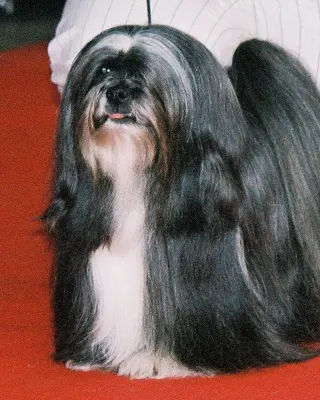
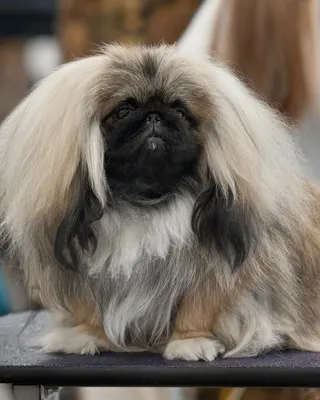
Plate 095 · Himalaya & Central Asia
Tibetan Spaniel
藏獚
“A monastery lookout from Tibet, small enough to sit on the wall.”
- Origin
- China
- Tibet (historical region)
- Historical region — not an exact birthplace
- Sources place it in Tibet as a cultural and historical region, larger than today's Xizang (Tibet) Autonomous Region; the marker uses that region's reference point and ties the breed to no modern unit. The FCI gives the country of origin as Tibet (China), under British patronage.
- The point is a reference position for a historical region; it is not an exact birthplace.
- Era
- Long kept in Tibetan monasteries; reportedly bred in Britain by the 1890s
- Today
- Companion · Watchdog
Under editorial review — sources listed below.
History
01 · Origin
Tibet (historical region)
A small, alert companion dog from Tibet, long associated with Buddhist monasteries.
02 · Historical role
What it was bred for
A companion and lookout: tradition has it sitting on monastery walls and barking to alert the monks and the larger Tibetan Mastiffs below.
03 · Breed development
How it changed
Small dogs were exchanged as gifts between Tibetan monasteries and the palaces of China and other Buddhist lands, so some think it shares ancestors with the Pekingese and Japanese Chin. It was reportedly bred in Britain by the 1890s; the first US litter recorded from imported monastery dogs was born in 1965.
04 · Today
Companion · Watchdog
A family companion that also takes part in agility, scent work and obedience.
Personality
- Playful
- Bright
- Self-confident
- Watchful
General breed tendencies, not guarantees — individual dogs vary with genetics, training and environment. Ratings: the AKC’s trait scores as its breed page gives them (the AKC’s 1–5 guidance for owners, not a measurement). Other profiles here use editorial ratings, a different source, so compare across them with care.
- Exercise
- A daily walk and play are enough, though many happily keep up on longer walks; a fenced yard is wise.
- Grooming
- Regular brushing, with extra combing behind the ears where it mats; no trimming beyond the feet.
- Training
- Bright and eager but independent-minded: start early and keep it positive.
Living with one
- Size
- Small
- Lifespan
- 12–15 years
- Coat
- Silky double coat of moderate length, with a mane on the neck and feathered ears and tail; any colour
Field note
Its ancestors in the monasteries were called 'Little Lions', and lions were held sacred.
Recognition & today
- AKC
- Non-Sporting Group
- Also recognized by
- FCI (Group 9, standard 231; patronage Great Britain), The Kennel Club (UK)
- Popular in
- No reliable data
AKC: Non-Sporting Group, recognized 1983.
AKC registrations: ranked 122 among breeds in 2025.
- 中国本土 / 历史犬种 · China-native or historic
Sources3 references
- Tibetan Spaniel — breed information — American Kennel Club
https://www.akc.org/dog-breeds/tibetan-spaniel/
Registry · accessed 2026-10-14 · Registry status, group, size, life expectancy and registration rank; history as the AKC tells it. Ratings: the AKC's own 1–5 owner-guidance trait scores as the page gives them (energy level, trainability, barking level, openness to strangers, good with other dogs), not measurements.
- Tibetan Spaniel — Wikipedia
https://en.wikipedia.org/wiki/Tibetan_spaniel
Encyclopedia · accessed 2026-10-14 · Monastery role, gift exchanges with Chinese palaces, likely kinship with Oriental breeds, UK breeding by the 1890s, first documented US litter (1965).
- Tibetan Spaniel — FCI breed nomenclature — Fédération Cynologique Internationale
https://www.fci.be/en/nomenclature/TIBETAN-SPANIEL-231.html
Kennel club · accessed 2026-10-14 · Country of origin Tibet (China); patronage Great Britain; Group 9; definitive acceptance 22 August 1961.
Text is written by World Breeds from the references above; it does not reproduce registry descriptions. Location note: Sources place it in Tibet as a cultural and historical region, larger than today's Xizang (Tibet) Autonomous Region; the marker uses that region's reference point and ties the breed to no modern unit. The FCI gives the country of origin as Tibet (China), under British patronage.