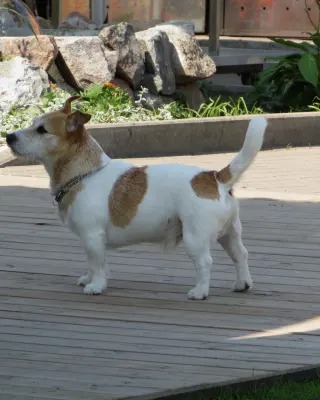
Plate 173 · British Isles
Parson Russell Terrier
帕森罗素㹴
“The sporting parson's terrier.”
- Origin
- United Kingdom
- Devon, south-west England
- Region of origin
- Bred from the terriers of the Reverend John Russell in Devon; the marker is Devon's reference point.
- The point marks the region the breed comes from, not an exact birthplace.
- Era
- From 1819
- Today
- Companion · Dog sports
Under editorial review — sources listed below.
History
01 · Origin
Devon, south-west England
A leggy, mostly white working terrier that could keep up with foxhounds; the recognised show variety of the Jack Russell type.
02 · Historical role
What it was bred for
Running with foxhounds and bolting foxes from their earths.
03 · Breed development
How it changed
By tradition, in 1819 the Reverend John Russell bought a white-and-tan terrier bitch, Trump, from a milkman; by the 1850s his dogs were recognised as a distinct type of fox terrier. Arthur Heinemann, who founded the Devon and Somerset Badger Club in 1894, drew up the first standard for the type; the AKC dates that standard to 1904. The Kennel Club recognized the Parson Jack Russell Terrier in 1990.
04 · Today
Companion · Dog sports
A lively companion and sports dog.
Personality
- Friendly
- Clever
- Athletic
- Bold
General breed tendencies, not guarantees — individual dogs vary with genetics, training and environment. Ratings: the AKC’s trait scores as its breed page gives them (the AKC’s 1–5 guidance for owners, not a measurement). Other profiles here use editorial ratings, a different source, so compare across them with care.
- Exercise
- High energy and strong prey drive: lots of exercise, on lead outdoors.
- Grooming
- Regular brushing; broken coats need plucking or clipping.
- Training
- Smart and easily bored: fun, varied, positive sessions.
Living with one
- Size
- Small
- Lifespan
- 13–15 years
- Coat
- Smooth or broken coat, mostly white with tan, lemon or black markings
Field note
By tradition, Russell's breeding began with Trump, a terrier bitch bought from a milkman in 1819.
Recognition & today
- AKC
- Terrier Group
- Also recognized by
- FCI (Group 3, standard 339), The Kennel Club (UK)
- Popular in
- No reliable data
AKC: Terrier Group, recognized 1997. Recognized by the AKC in 1997 as the Jack Russell Terrier and renamed in 2003. The shorter, longer-bodied Jack Russell Terrier of the FCI standard is a separate breed (the AKC's Russell Terrier) with its own profile.
Kept as a companion and sports dog. AKC registrations: ranked 121 among breeds in 2025.
Sources3 references
- Parson Russell Terrier — breed information — American Kennel Club
https://www.akc.org/dog-breeds/parson-russell-terrier/
Registry · accessed 2026-10-14 · Registry status, group, size, life expectancy and registration rank; history as the AKC tells it. Ratings: the AKC's own 1–5 owner-guidance trait scores as the page gives them (energy level, trainability, barking level, openness to strangers, good with other dogs), not measurements.
- Parson Russell Terrier — Wikipedia
https://en.wikipedia.org/wiki/Parson_Russell_Terrier
Encyclopedia · accessed 2026-10-14 · Rev. John Russell and Trump (1819), Heinemann's 1894 standard, Kennel Club recognition (1990), AKC recognition as Jack Russell Terrier (1997), the renaming.
- Parson Russell Terrier — FCI breed nomenclature — Fédération Cynologique Internationale
https://www.fci.be/en/nomenclature/PARSON-RUSSELL-TERRIER-339.html
Kennel club · accessed 2026-10-14 · Country of origin Great Britain; Group 3, section "Large and medium sized Terriers"; accepted 2001.
Text is written by World Breeds from the references above; it does not reproduce registry descriptions. Location note: Bred from the terriers of the Reverend John Russell in Devon; the marker is Devon's reference point.