Plate 094 · Mediterranean
Pharaoh Hound
法老王猎犬
“Malta's national rabbit dog, said to blush when excited.”
- Origin
- Malta
- Country of origin
- A Maltese breed. The AKC repeats the tradition that it descends from the hounds of ancient Egypt; a 2023 study found the Kelb tal-Fenek strongly diverged from today's Egyptian street dogs but could not exclude an ancient common relationship, and a 2012 genome-wide study found no distinct 'basal' signature in it; its authors tie that signature to isolation from other breeds rather than to age, and note that later crossing between breeds blurs older ancestry. The tradition is neither confirmed nor ruled out.
- The point is a reference position in the country of origin.
- Era
- Traditional on Malta; standardized from the 1960s
- Today
- Hunting dog · Companion
Under editorial review — sources listed below.
History
01 · Origin
Malta
Malta's rabbit dog (Kelb tal-Fenek), a lean, tan hound that hunts by scent and sight on rocky ground.
02 · Historical role
What it was bred for
Hunting rabbits in Malta's stony countryside, traditionally at night.
03 · Breed development
How it changed
The English name reflects a claimed link to the hounds of Egyptian tomb art, which genetic studies have neither confirmed nor ruled out. A 1647 description of Maltese rabbit dogs may refer to it. The first litter born outside Malta was in the UK in 1963, the year the FCI accepted the breed; it became Malta's national dog in 1979.
04 · Today
Hunting dog · Companion
Still a hunting dog on Malta; elsewhere a companion and show dog.
Personality
- Friendly
- Smart
- Graceful
- Playful
General breed tendencies, not guarantees — individual dogs vary with genetics, training and environment. Ratings: the AKC’s trait scores as its breed page gives them (the AKC’s 1–5 guidance for owners, not a measurement). Other profiles here use editorial ratings, a different source, so compare across them with care.
- Exercise
- Needs regular exercise; it should run free only in a high, securely fenced area, otherwise walk it on lead.
- Grooming
- Light daily or firmer weekly brushing; keep ears clean and nails short.
- Training
- Quick to learn and eager to please, but most will not come when called once loose in an open area.
Living with one
- Size
- Medium
- Lifespan
- 12–14 years
- Coat
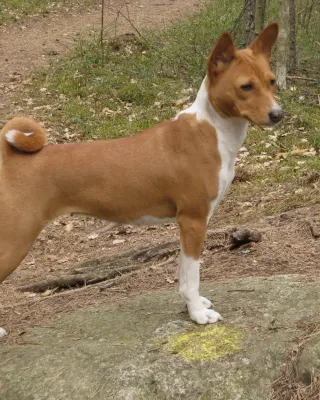
- Short, glossy coat in tan to chestnut, sometimes with white on the chest and tail tip
Field note
Its nose and ears can flush a deeper pink when it is excited, which earned it the nickname 'the blushing dog'.
Recognition & today
- AKC
- Hound Group
- Also recognized by
- FCI (Group 5, standard 248; patronage UK), The Kennel Club (UK)
- Popular in
- No reliable data
AKC: Hound Group, recognized 1983.
A traditional rabbit-hunting dog of rural Malta. AKC registrations: ranked 180 among breeds in 2025.
Sources5 references
- Pharaoh Hound — breed information — American Kennel Club
https://www.akc.org/dog-breeds/pharaoh-hound/
Registry · accessed 2026-10-14 · Registry status, group, size, life expectancy and registration rank; history as the AKC tells it. Ratings: the AKC's own 1–5 owner-guidance trait scores as the page gives them (energy level, trainability, barking level, openness to strangers, good with other dogs), not measurements.
- Pharaoh Hound — Wikipedia
https://en.wikipedia.org/wiki/Pharaoh_Hound
Encyclopedia · accessed 2026-10-14 · Maltese name and use, a DNA study of its distance from Egyptian street dogs, other DNA studies suggesting a fairly recent development, a 1647 description some take to mean the breed, first litter outside Malta and FCI acceptance (1963).
- Pharaoh Hound — FCI breed nomenclature — Fédération Cynologique Internationale
https://www.fci.be/en/nomenclature/PHARAOH-HOUND-248.html
Kennel club · accessed 2026-10-14 · Country of origin Malta; Group 5, section "Primitive type"; definitive acceptance 9 August 1963.
- Rethinking dog domestication by integrating genetics, archeology, and biogeography (Larson et al., PNAS 2012) — Proceedings of the National Academy of Sciences
https://pmc.ncbi.nlm.nih.gov/articles/PMC3384140/
Academic · accessed 2026-10-16 · Genome study of modern breeds; read: abstract and the paragraph naming the Pharaoh and Ibizan Hounds.
- Phylogeographic and population genetic structure of hound-like native dogs of the Mediterranean Basin (Perini et al., Res Vet Sci 2023) — Research in Veterinary Science (Elsevier)
https://doi.org/10.1016/j.rvsc.2023.01.010
Academic · accessed 2026-10-16 · Read: abstract only (full-text repository copies returned HTTP 403).
Text is written by World Breeds from the references above; it does not reproduce registry descriptions. Location note: A Maltese breed. The AKC repeats the tradition that it descends from the hounds of ancient Egypt; a 2023 study found the Kelb tal-Fenek strongly diverged from today's Egyptian street dogs but could not exclude an ancient common relationship, and a 2012 genome-wide study found no distinct 'basal' signature in it; its authors tie that signature to isolation from other breeds rather than to age, and note that later crossing between breeds blurs older ancestry. The tradition is neither confirmed nor ruled out.