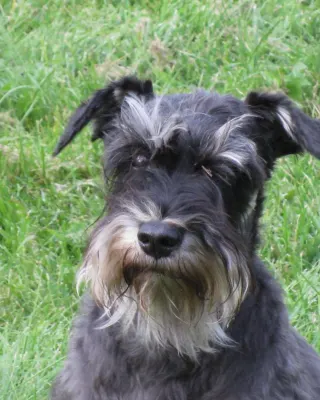
Plate 197 · Continental Europe
Standard Schnauzer
标准雪纳瑞
“The original schnauzer.”
- Origin
- Germany
- Southern Germany (Bavaria)
- Region of origin
- The schnauzer comes from southern Germany; the marker is Bavaria's reference point.
- The point marks the region the breed comes from, not an exact birthplace.
- Era
- Shown from 1879; developed as a breed from the 1880s
- Today
- Companion · Working dog
Under editorial review — sources listed below.
History
01 · Origin
Southern Germany (Bavaria)
The original, medium-sized schnauzer: a bearded German farm and stable dog.
02 · Historical role
What it was bred for
Ratting in stables, running with carriages and guarding farms.
03 · Breed development
How it changed
Rough-haired and smooth pinschers came from one lineage and could appear in the same litter; the rough ones became the schnauzer. A dog named 'Schnautzer' won the wire-haired pinscher class at Hanover in 1879. The German army used it as a dispatch carrier and Red Cross aide. Its pepper-and-salt variety is on the Red List of the German conservation society GEH as endangered (category III, 2026).
04 · Today
Companion · Working dog
A watchdog, sports dog and companion.
Personality
- Fearless
- Smart
- Spirited
- Watchful
General breed tendencies, not guarantees — individual dogs vary with genetics, training and environment. Ratings: the AKC’s trait scores as its breed page gives them (the AKC’s 1–5 guidance for owners, not a measurement). Other profiles here use editorial ratings, a different source, so compare across them with care.
- Exercise
- Energetic; loves long hikes and to be included in family life.
- Grooming
- Hand-stripping keeps the wiry coat weather-resistant; weekly care of beard and legs.
- Training
- Very intelligent and crafty: learns fast, bores fast.
Living with one
- Size
- Medium
- Lifespan
- 13–16 years
- Coat
- Harsh, wiry double coat with beard and eyebrows; pepper-and-salt or black
Field note
A Standard Schnauzer won Best in Show at Westminster in 1997.
Recognition & today
- AKC
- Working Group
- Also recognized by
- FCI (as Schnauzer, Group 2, standard 182), VDH (Germany)
- Popular in
- No reliable data
AKC: Working Group, recognized 1904.
In Germany the pepper-and-salt variety is on the GEH Red List as endangered. AKC registrations: ranked 93 among breeds in 2025.
Sources3 references
- Standard Schnauzer — breed information — American Kennel Club
https://www.akc.org/dog-breeds/standard-schnauzer/
Registry · accessed 2026-10-14 · Registry status, group, size, life expectancy and registration rank; history as the AKC tells it. Ratings: the AKC's own 1–5 owner-guidance trait scores as the page gives them (energy level, trainability, barking level, openness to strangers, good with other dogs), not measurements.
- Standard Schnauzer — Wikipedia
https://en.wikipedia.org/wiki/Standard_Schnauzer
Encyclopedia · accessed 2026-10-14 · Southern German origin, shared history with the German Pinscher, the 1879 Hanover show, the name, endangered status, Westminster 1997.
- Schnauzer — FCI breed nomenclature — Fédération Cynologique Internationale
https://www.fci.be/en/nomenclature/SCHNAUZER-182.html
Kennel club · accessed 2026-10-14 · Country of origin Germany; Group 2, section "Pinscher and Schnauzer type"; accepted 1955.
Text is written by World Breeds from the references above; it does not reproduce registry descriptions. Location note: The schnauzer comes from southern Germany; the marker is Bavaria's reference point.