Plate 201 · Himalaya & Central Asia
Tibetan Terrier
西藏㹴
“The Tibetan 'luck bringer' that is not a terrier.”
- Origin
- China
- Tibet (historical region)
- Historical region — not an exact birthplace
- Its Tibetan name, Tsang Apso, links it to the Tsang region. The marker is the reference point of today's Xizang (Tibet) Autonomous Region and ties it to no modern unit. The FCI gives the country of origin as Tibet (China).
- The point is a reference position for a historical region; it is not an exact birthplace.
- Era
- Kept in Tibet for a long time; in Europe from 1922
- Today
- Companion
Under editorial review — sources listed below.
History
01 · Origin
Tibet (historical region)
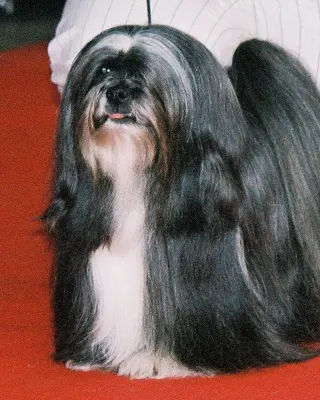
A medium-sized, shaggy Tibetan dog that is not a terrier at all: a companion, watchdog and herder.
02 · Historical role
What it was bred for
A good-luck companion, watchdog and herder; said also to retrieve things dropped down mountainsides.
03 · Breed development
How it changed
European travellers named it 'terrier' for its size. Dr Agnes Greig brought the first to Europe in 1922, a puppy given to her after an operation she performed; her first litter, in 1924, was registered as Lhasa Terriers, renamed Tibetan Terriers in 1930. The claim that monasteries have bred it for 2,000 years is not adopted as a date.
04 · Today
Companion
A companion.
Personality
- Loyal
- Affectionate
- Sensitive
- Independent
General breed tendencies, not guarantees — individual dogs vary with genetics, training and environment. Ratings: the AKC’s trait scores as its breed page gives them (the AKC’s 1–5 guidance for owners, not a measurement). Other profiles here use editorial ratings, a different source, so compare across them with care.
- Exercise
- Varies by dog, from home-lover to mountain hiker.
- Grooming
- The long double coat needs grooming; some owners keep it in a shorter puppy cut.
- Training
- Independent and quick; withers under repetition or harsh methods.
Living with one
- Size
- Small
- Lifespan
- 15–16 years
- Coat
- Profuse double coat with a woolly undercoat, fine and long; any colour
Field note
Its Tibetan name, Tsang Apso, means roughly 'shaggy dog from Tsang'.
Recognition & today
- AKC
- Non-Sporting Group
- Also recognized by
- FCI (Group 9, standard 209)
- Popular in
- No reliable data
AKC: Non-Sporting Group, recognized 1973.
Best known as a companion and watchdog. AKC registrations: ranked 118 among breeds in 2025.
- 中国本土 / 历史犬种 · China-native or historic
Sources3 references
- Tibetan Terrier — breed information — American Kennel Club
https://www.akc.org/dog-breeds/tibetan-terrier/
Registry · accessed 2026-10-14 · Registry status, group, size, life expectancy and registration rank; history as the AKC tells it. Ratings: the AKC's own 1–5 owner-guidance trait scores as the page gives them (energy level, trainability, barking level, openness to strangers, good with other dogs), not measurements.
- Tibetan Terrier — Wikipedia
https://en.wikipedia.org/wiki/Tibetan_Terrier
Encyclopedia · accessed 2026-10-14 · The name and Tsang Apso, traditional roles, Dr Agnes Greig (1922), the 1924 litter and 1930 renaming, first US imports (1956), AKC 1973.
- Tibetan Terrier — FCI breed nomenclature — Fédération Cynologique Internationale
https://www.fci.be/en/nomenclature/TIBETAN-TERRIER-209.html
Kennel club · accessed 2026-10-14 · Country of origin Tibet (China); Group 9, section "Tibetan breeds"; accepted 1957.
Text is written by World Breeds from the references above; it does not reproduce registry descriptions. Location note: Its Tibetan name, Tsang Apso, links it to the Tsang region. The marker is the reference point of today's Xizang (Tibet) Autonomous Region and ties it to no modern unit. The FCI gives the country of origin as Tibet (China).