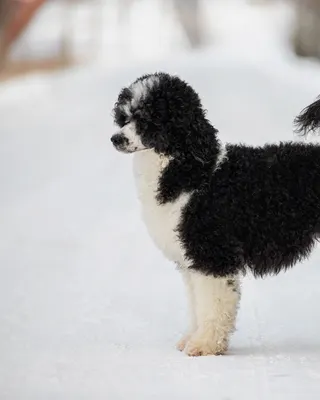
Plate 194 · Mediterranean
Spanish Water Dog
西班牙水犬
“Spain's all-purpose water dog.”
- Origin
- Spain
- Spain: Andalusia and the Cantabrian coast
- Region of origin
- Three traditional populations were found in Andalusia and on the Cantabrian coast; the first scientific study was of the dogs of Málaga, whose reference point is the marker.
- The point marks the region the breed comes from, not an exact birthplace.
- Era
- Traditional; recognized in Spain 1975
- Today
- Herding dog · Companion
Under editorial review — sources listed below.
History
01 · Origin
Spain: Andalusia and the Cantabrian coast
A medium-sized, woolly-coated Spanish dog that herded livestock, retrieved game in marshes and helped fishermen.
02 · Historical role
What it was bred for
Herding sheep and cattle, retrieving in marshlands, and assisting inshore fishermen.
03 · Breed development
How it changed
Numbers fell sharply in the 1970s–80s as farming and fishing changed. Studies in Málaga and Córdoba found three populations: the marsh dog of the Guadalquivir, the sierra dog of southern Andalusia, and the smaller northern dog, recognized in 2012 as the separate Cantabrian Water Dog. The Spanish kennel club recognized the breed in 1975.
04 · Today
Herding dog · Companion
A companion and sports dog.
Personality
- Upbeat
- Playful
- Work-oriented
- Active
General breed tendencies, not guarantees — individual dogs vary with genetics, training and environment. Ratings: the AKC’s trait scores as its breed page gives them (the AKC’s 1–5 guidance for owners, not a measurement). Other profiles here use editorial ratings, a different source, so compare across them with care.
- Exercise
- A good run daily once mature; a great hiking partner.
- Grooming
- Never brushed: clipped evenly, or left to cord.
- Training
- Highly intelligent and biddable; enjoys clicker training.
Living with one
- Size
- Medium
- Lifespan
- 12–14 years
- Coat
- Woolly, curly coat that forms cords if left long; never brushed
Field note
It was once nicknamed 'the Turkish dog', after one theory of where it came from.
Recognition & today
- AKC
- Herding Group
- Also recognized by
- FCI (Group 8, standard 336), Real Sociedad Canina de España
- Popular in
- No reliable data
AKC: Herding Group, recognized 2015.
Kept mainly as a companion today. AKC registrations: ranked 167 among breeds in 2025.
Sources3 references
- Spanish Water Dog — breed information — American Kennel Club
https://www.akc.org/dog-breeds/spanish-water-dog/
Registry · accessed 2026-10-14 · Registry status, group, size, life expectancy and registration rank; history as the AKC tells it. Ratings: the AKC's own 1–5 owner-guidance trait scores as the page gives them (energy level, trainability, barking level, openness to strangers, good with other dogs), not measurements.
- Spanish Water Dog — Wikipedia
https://en.wikipedia.org/wiki/Spanish_Water_Dog
Encyclopedia · accessed 2026-10-14 · Traditional uses, decline in the 1970s–80s, studies in Málaga province and at the University of Córdoba, the three populations and the Cantabrian Water Dog (2012), recognition (1975, FCI 1999).
- Spanish Water Dog — FCI breed nomenclature — Fédération Cynologique Internationale
https://www.fci.be/en/nomenclature/SPANISH-WATER-DOG-336.html
Kennel club · accessed 2026-10-14 · Country of origin Spain; Group 8, section "Water Dogs"; accepted 1999.
Text is written by World Breeds from the references above; it does not reproduce registry descriptions. Location note: Three traditional populations were found in Andalusia and on the Cantabrian coast; the first scientific study was of the dogs of Málaga, whose reference point is the marker.